| I have the genes of an athlete, but I did not know long. I have the genes of a geek - that I could not ignore. Son of a professor and teacher, grand-son of teachers, great-grand-son of teachers - pretty obvious I was born for the book rather than for sneakers. |
Monday, August 9, 2010
A bit of history (without going to the Roman times)

Sunday, April 18, 2010
My first podium (if I can say so)
| Yes, that's it. I knew- I'm in shape! Today at Scotiabank 5 km, I have proved. It was chilly, the wind was quite unpleasant, but I was ready. At 23: 19.9, I improved my personal best by 30 seconds (less than 1 / 10 sec, to be precise). Beyond that, I reached a 48th place amongst 768 participants and, even better, the 2nd place in my age group. No medal around the neck, but a second place is honest! |
Saturday, April 10, 2010
VO2 Max Test (2) - results
Finally, I received my VO2 Max. test results. Quite interesting!
Lactates (causing fatigue) and VO2 Max rise regularly, which means that I am in excellent physical condition. The anaerobic threshold is around HR of 167 beats, or when lactate exceeds the value of 4. The last two columns show respectively the total consumption of calories per minute and how much fat I burn per minute. We can conclude that I burn the most calories from fat at low speeds (this is known), but the total calories burned are highest, of course, in the upper zones. ![clip_image002[4]](http://lh3.ggpht.com/_GR2lZmuLC9E/S7_VnwoEh0I/AAAAAAAAAzQ/oFh1wtwe8WE/s1600-h/image%5B2%5D.png "clip_image002[4]") ![clip_image004[4]](http://lh3.ggpht.com/_GR2lZmuLC9E/S7_VpzkYa4I/AAAAAAAAAzY/tUhBBh1Z2ts/s1600-h/image%5B5%5D.png "clip_image004[4]") The graphs show the same things. We see that the curve of lactate (No. 1) rises suddenly after 4 mMol. The other graph shows the linear rise of HR and Vo2 Max. What surprised me the most was the distribution of my training zones.
|
Saturday, April 3, 2010
VO2Max Test
| Since last Thursday, I feel like a real athlete. A true one. Because that day, I passed my VO2Max test. I did what the serious athletes do. It’s further evidence that I consider the race very seriously. Already I have a nice library of books of running, I read the serious sites, I use the technology for my workouts ... I was missing only the VO2Max test. |
 The test looks like this (see image above) |
Sunday, May 3, 2009
Cotton T-Shirts
| So, spring is back, nice weather seems to be here for some time and we run more often, isn’t it? Recently, I was with my friend on Mount Royal. We ran under the warm sun when a girl just passed as by. Provocation! No, it wasn’t her, nor the fact that she passed us by, but the fact that she wore a cotton t-shirt. No, no! Just the fact that a runner wears cotton apparel makes me feeling bad. So, what is that bad with cotton? Everything. It is the worst material in the world to put on when exercising (no matter the sport). It doesn’t wick the humidity (sweat), even on the contrary, it will absorb it, your tee will become heavy and uncomfortable and if there is a wind, you have all the chances to become sick. Actually, polyester is much better and became the obvious choice for tees and shorts, and even the socks are made in materials that wicks humidity and allow to your feet to stay fresh and without blisters (great, it doesn’t stink and moreover it is comfortable). Unfortunately, during our workout we saw several runners in cotton t-shirts. Maybe they just don’t know that polyester exists (I frankly doubt, but…) or think it is too expensive. No, polyester tees are really not expensive and you can wear them for years. They dry quickly so can be reused after several hours. The top models offer even the UV and antibacterial protection (no smell!). So, what are you waiting? If you already don’t have one, go to your running store and buy a polyester T-Shirt. You’ll feel much better under the sun. |
Friday, March 21, 2008
Fit, in spite of the age
| Another day, I read about Buster Martin, a 101 years old Brit who recently finished a half-marathon (the time is really not important) and is preparing for his first full marathon - London Marathon, in few weeks. Almost every day I see in a gym men in their 70s, doing their workouts on a treadmill or with weights (not too big, to be honest, but anyway). And finally - my source of inspiration since I started running - a phenomenon called Ed Whitlock. This Milton (Ontario) resident, born in 1931, is a real running machine and an exceptional motivator. Can you imagine - this man, record holder of 13 world records in different age categories, ran a full marathon (42,195 km, 26 miles 385 yards, use any unit of measure you like - it's veeery far)in less than three hours. At the age of 75! He runs between 2 and 3 hours every single day. What his heart looks like? I can imagine it as a well oiled (not because of the fat) and maintained pump that will function for many years to come. The idea is to do the workouts, stay fit and help out body to continue doing well even at the advanced age and preserving our physical and mental health - without using the drugs. We really don't need to stimulate the pharmaceutical industry. They are already too rich. Let's rather help ourselves to stay healthy at the age of 70,80, 90... years. I can't imagine myself running a full marathon in less than 3 hours at the age of 75 (like Ed Whitlock did), but running 5 or 10 K at the ago of 65 - why not? And after that, we'll see. It's already much better than most of the people around us do.  Ed Whitlock |
Saturday, November 24, 2007
Add some jogging?
| I hope that some of you started fitness more than six months ago. If so, you might be interested to introduce some jogging into your daily activity. About a year after I started my weight lose program, I started to jog occasionally. Then, I felt that I needed some more speed. If you are like that, the following program is for you. If not, continue with you current program until you achieve your goals. WARNING:If you have heart related problems or you just think you might have them, consult a qualified physician before you change a program. |
Program for advanced walkers/joggers
| Day | Intensity |
| Monday | (day off) |
| Tuesday (short day) | Warm up for 5 to 10 minutes; 30min @ 50-70% MaxHR (alternate 5 min walk/ 1 min light jog)* ; slow down for 5 minutes. Light stretching. |
| Wednesday (short day) | (same as Tuesday) |
| Thursday (long day) | Warm up for 5 to 10 minutes; 60 min @ 50-70% MaxHR; slow down for 5 minutes. Light stretching. |
| Friday (short day) | (same as Tuesday) |
| Saturday (long easy day) | Warm up for 5 to 10 minutes; 30 min @ 50-70% MaxHR; 30-60 additional minutes @ 50-60% MaxHR; slow down for 5 minutes. Light stretching. |
| Sunday (long day) | (same as Thursday) |
| *Every four weeks, you can increase light jog by 1 min until you walk for 5 minutes and jog for the same amount of time. Your total workout time shouldn't change (max 30 min). Only the number of intervals will change. BTW, this will increase the amount of calories burned, and if your goal is a weight loss, this will help you to get rid off the pounds a little bit faster. |
Sunday, November 18, 2007
Program for advanced walkers
Program 1 (5 months of training and more)
| Day | Intensity |
| Monday | (day off) |
| Tuesday | 30 min;Alternate 5 min at 50-60% HRM with 2 min at 60-70%. Finish with 2 min at 50-60%. |
| Wednesday | 30 min @ 50-60% HRM |
| Thursday | 15 min @ 50-60% HRM |
| Friday | 30 min @ 50-60% HRM |
| Saturday | 15 min @ 50-60% HRM |
| Sunday | (same as Tuesday) |
Program 2
| Day | Intensity |
| Monday | (day off) |
| Tuesday (short day) | Warm up for 5 to 10 min; 30 min at 50-70% MaxHR; slow down for 5 minutes. Light stretching. |
| Wednesday (short day) | (same as Tuesday) |
| Thursday (long day) | Warm up for 5 to 10 min; 60 min at 50-70% HRM; slow down for 5 min. Light stretching. |
| Friday (short day) | (same as Tuesday) |
| Saturday (long easy day) | Warm up for 5 to 10 minutes; 30 min at 50-70% HRM; 30-60 additional minutes at 50-60%; slow down for 5 minutes. Light stretching. |
| Sunday (long day) | (same as Thursday) |
Friday, November 9, 2007
Interesting question
I continued running, but few minutes later, probably not convinced that somebody could run for pleasure, the lady asked me the same question. I stopped and explained her how I lost weight, started walking and running, etc. I finished with the same sentence as few minutes ago: "And now, I run because I like it."
This is true. I am not obliged to run but I like it so much that I cannot stop doing it. I hope you'll like walking and, eventually, running, too.
This is no more a matter of fitness or health. This is a Passion!
Sunday, October 21, 2007
Program (intermediate level)
* maxHR = maximum Heart Rate
|
Sunday, October 14, 2007
Did you start to walk?
| Try our poll (left) and be honest :). It's for your good. If you already started - BRAVO! Just go on! IF you want to start, but don't find some time, try something else: use the stairs instead of the elevator, walk to the store instead of driving (well, if it isn't at 10 km). The well known tricks :) If you want to progress (hey, it means that you already walk!), I offer two beginners programs. Find some time for yourself 3 or 4 times a week. |
|
Beginners 1 (less than 4 weeks of walking):
* maxHR = maximum Heart Rate (see 2007-28-02, Workouts with Heart Zones) Beginners 2 (between 4 and 8 weeks of training):
|
Wednesday, October 3, 2007
CIBC Run For The Cure
 |  |
 |  |
 |  |
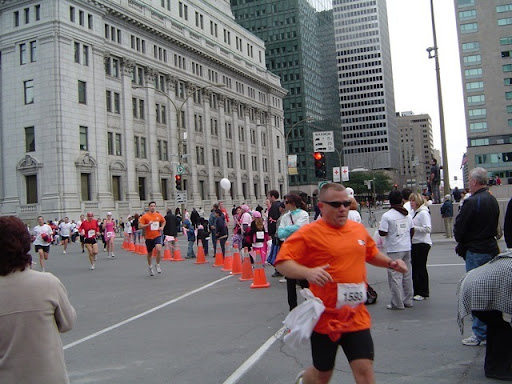 | 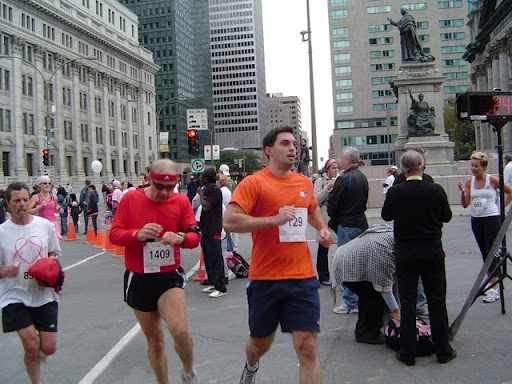 |
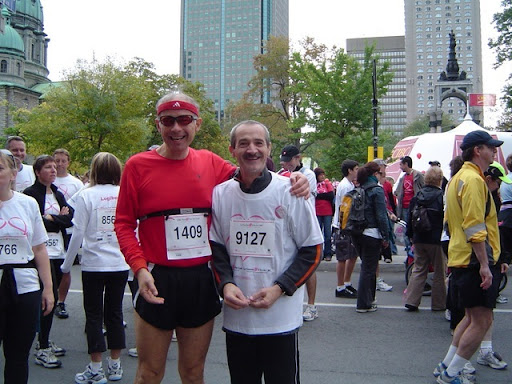
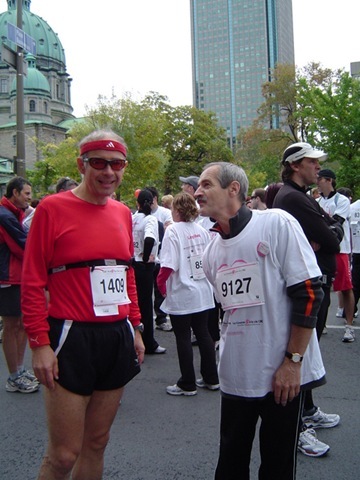
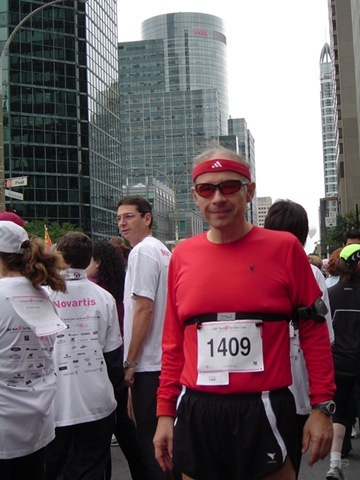
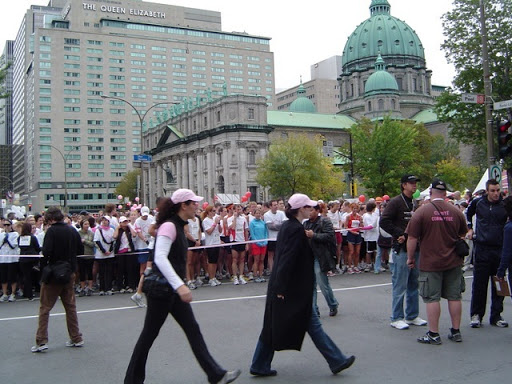
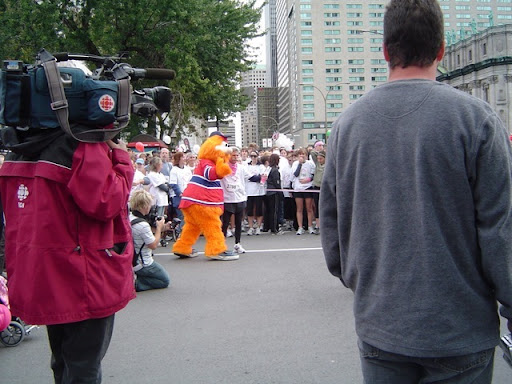
| Isn't it fantastic? A crowd of 25 000 gathered this weekend in Montreal to walk and run for Canadian Breast Cancer Foundation. Everyone can do something to help find the cure for breast cancer - a donation and a participation. Every little thing that gives hope that one day this illness will disappear or, at least, be easier to prevent and cure. Together, we can do more than individually, so let's run, walk, meet... For a new hope and a better future of women and men (yes, event the men can have this form of cancer - only this year, 170 men in Canada, 80 in Austria, etc. will be diagnosed with this illness). And gather in even bigger number next year! |
Friday, September 28, 2007
Is Running Really Boring?
| When I was younger, I often watched a very long dyke in my birthplace (well, maybe I just thought it was that long). And, there were runners, too. I wondered how they could run every day without being bored. Another day, while I discussed with my dad (a former athlete, but not runner), I mentioned running and he told me that running on streets is probably interesting, and running on track must be “terribly boring”. Few years ago, I would have thought he was right. Not anymore! To walk or run, one must have good legs (strong, not pretty), but the mental side is also important. A physical activity is equally a matter of muscles as of thinking. When I started to walk, I always used my PM3 player and listened to the music. Once, I forgot it (but it was too late to come back). So, I started making music in my mind and understood that my brain was there to motivate me. Some time later, I understood that the workout time is my special time for relaxation. | That’s when I am concentrated only on running and on my environment. Even now, I use some songs in my mind to find a good rhythm for running and since one year I don’t use my MP3 during the workouts. Do you still remember the dyke from the beginning of this post? It is still as long as before, but now I know I can pass from one end to another very fast. Neither running on track is boring. I understand that this way I can improve my performance, especially the speed. So, what is the answer to the question from the title? Definitely, running is not boring. It is only our perception (when we are not motivated) that makes it boring. So, go outside and move… |
Friday, September 14, 2007
What I ate?
| IMPORTANT: Don't even try to eat like me. Our individual needs are different (according to our physical constitution, metabolism, level of the physical activity, etc.). This is only an example of my menu. Don't change anything in your eating habits without consulting a qualified nutritionist. |
| Breakfast: a glass of cereal with a glass of milk, half banana Variant: Two slices of multigrain bread with peanut butter and a glass of milk Snack: one fruit Lunch: Meat or fish; two slices of bread or potatoes/pasta; lettuce or tomato, ten pieces of baby carrots Snack: one fruit Supper: If I ate fish for lunch, I eat meat and vice-versa; cooked vegetables/salad; bread, potatoes or pasta Before going to bed: a glass of 1% milk or fat free yogurt I ate (and still eat) a lot of fish (salmon, tuna, sardines, mackerel). I use canned or fresh fish - the latter prepared in the oven or in microwave with a lot of spices and some olive oil. It helped me to get rid of cholesterol. When you see what I ate, are you surprised I wasn't hungry? |
Sunday, September 9, 2007
Montreal Marathon's 5 K (Sep. 9)
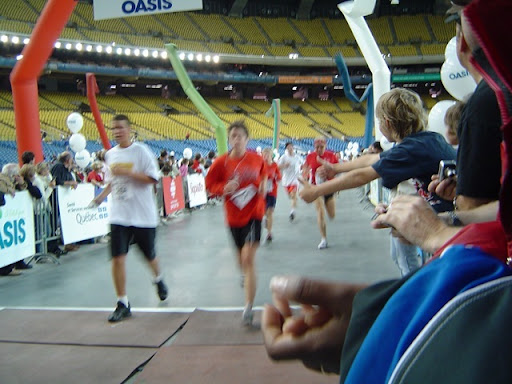
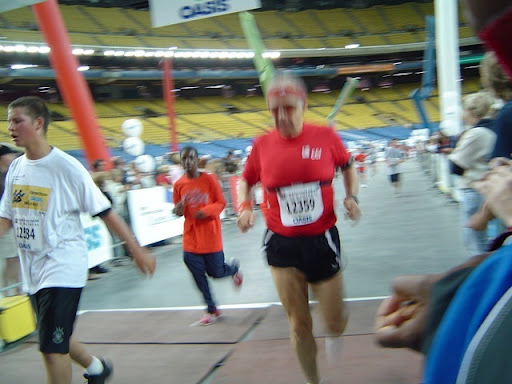
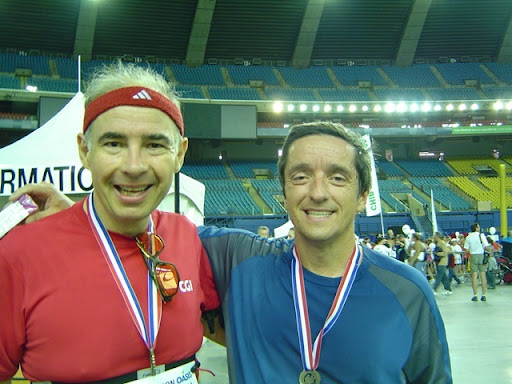
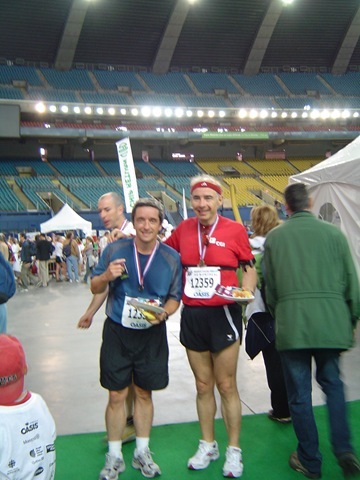
| I am so excited! I set my new personal best on 5 K (24:20). It was a great race. For the first time I was faster than 25 minutes (my old PB was 25:27). The weather was fair (around 15°C, somewhat windy) and I was in great shape. Unfortunately, on the water stop, a guy in front of me stopped suddenly so I ran into him and lost few precious seconds and my rhythm was broken. My running buddy Yves avoided this situation. He set his new PB, too. One of my toes is painful (did the guy at the water stop stepped on my foot?) but I'll continue my workouts this week preparing for the next race (in 3 weeks). |
|
|
|
|
Monday, September 3, 2007
Start using a Heart Rate Monitor
What’s the use of a heart rate monitor?
1) You don’t have to stop occasionally to measure your pulse.
2) You can set the alarm so whenever you are too low or too high (if you prefer: when you are out of your training zone), the alarm will remind you to accelerate or to slow down a bit.
3) You can set the timer to remind you when to stop the workout.
4) At the end, you’ll see the statistics (average heart rate, maximum and minimum HR), sometimes even the total time you exercised in your target zone.
You can put all of this to a chart and this will motivate you more than you imagine. I was so amazed with these numbers that I entered them after every workout and was impatient to do. You can even add your morning weight and calculate the daily or weekly progress. Amazing! I did it after two months since the beginning f my program and it was one of the most motivating things I used.
As it was written on About.com - Sports Medicine, Heart Monitor is a gadget you can live without, but once you try it, you’ll be hardly able to continue without it.
Right, you become addicted! You find it so easy to use and so useful, that you want one during each of your workouts. HRM is not a tool for advanced athletes (although they use them, too). You can find them in various shapes, with so different characteristics – from base models, to fitness and running or cycling computers. Every one will monitor your heart rate in real time, most of them have the chronometer, most will be able to set your five heart zones (but you’ll have to enter your maximum HR yourself), some can even calculate your calories consumption during the workout. Mostly, they have a timer, so you can set the time you want doing your workout (ex: 24 minutes) and will remind you that your exercise is over.
The advanced ones will show you the distance you walked (or ran) – based either on GPS signal or by using a foot pod. Some will even allow you to set your workouts on a computer and to transfer them to your watch and exercise according to the programmed session. Some of the famous brands are Polar, Timex and, recently, Garmin. Polar and Timex have basic to advanced models, Garmin only the advanced ones. I would not recommend the Heart Rate Monitors without a chest strap because they are not accurate.
Basically, you moisten your chest strap and put it on your chest, start your watch in chronometer mode and GO! Don’t forget to warm-up and cool down!
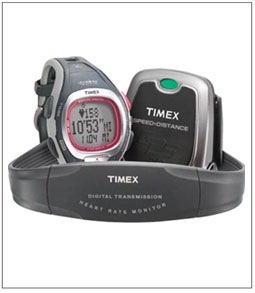 | 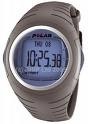 | 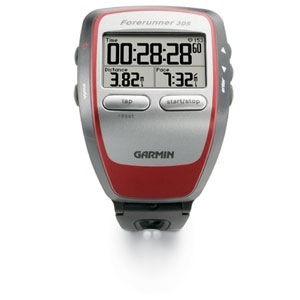 |
| Timex Bodylink | Polar F4M | Garmin 305 |
Saturday, August 25, 2007
My first month
In fact, I started with 3780 steps/30 minutes and at the end of the month (after 11 workouts) I did 4550 steps/35 minutes.
At the end of May (1 and a half months after I started), I walked 45 minutes and around 6500 steps. In the beginning, I didn't do any statistics about the lost weight, but between April 10 and May 15, I lost 11 kg.
Not everybody must and can lose that weight so quickly, but it is quite obvious: when you are obese, you need more energy to move than when you are lean. Just imagine pushing a 10 kg box and a 50 kg box. For which one will you need more effort?
Moreover, I drastically cut in my calories intake, especially sugars. Probably I also dehydrated a little bit because I was taking some water only when I was thirsty. Now, I know it was wrong. You should drink water regularly, before you feel thirsty because it means that you are already dehydrated.
The marathoners do it like this (me too - now): one or two sips of water every 10 minutes of workout, no matter if you feel thirsty or not.
Sunday, August 19, 2007
Running Room 3 miler Race - Aug 11, 2007


Saturday, August 11, 2007
Taking heart rate and the first workouts
There are many ways to measure your heart rate, but the most accurate is by using a Heart Rate Monitor (HRM). While you walk or run, you can see in real time your heart rate.
If you don’t have a HRM, you can stop and take you pulse on the neck or on the wrist, but don’t forget that your heart rate will continue dropping while you are stopped. This means that there will be a discrepancy compared to a heart rate while you run or walk.
When you calculate the limits of your heart zones, try walking in a pace that will allow you to stay in your defined zones (1 or 2).
Before starting every workout, warm up by walking for five minutes – you have to gradually increase your heart rate from below 60% to a desired level.
After the workout, cool down by gradually decreasing your speed for 3 to 5 minutes to avoid that the blood (used while you were walking) returns too fast to the organs and in order to relax the muscles.
For the first week, I would recommend 15 to 20 minutes of walking in the first two zones (plus warm up and cool down). This gives the total of 25 to 30 minutes of activity. Try to exercise every other day or at least three times a week but not three days in a row and do not skip more than two days.
During the workouts, take one or two sips of water every 10 to 15 minutes (depending on your sweating and the air temperature/humidity) and avoid exercising during the heat periods. This means that in summer the best time for workouts is either early in the morning or late in the evening.
Don't forget - do not exercise at least 1.5 or hours after a meal and don't eat for at least 20 minutes after the workout. However, 30 minutes after the workout are important for recovery so take, for example a cup of chocolate milk (not too cold!) or cocoa or any other similar combination of proteins and carbs after the exercise. I found that the chocolate milk works perfectly for me.Thursday, August 2, 2007
Workouts with Heart Zones
To avoid too many scientific details, I’ll simply try to explain what it is.
The top triathlete Sally Edwards (today in her 50’s) is one of persons that prone this kind of fitness preparation. By simply following her advices, I lost weight and achieved the fitness level I could only dream of when I was younger.
The theory says that everybody a maximum heart rate (MaxHR). This number is not age dependent, is inherited and is sport dependent. Although there were many proofs that the widely accepted formula is no more valid (there is a difference of up to 20 beats compared to a real world data), the formula is still in use. This formula is based on a person’s age and now we know that a fit person can preserve its high maximum for years.
In the beginning, I also used this formula and lost quite a lot of weight (but later, I replaced it with another one, more precise), so it can be a kind of starting point.
So, let’s start with this formula that states:
MaxHR = 220 – age (in years)
In theory, a person 30 years old has MaxHR of 190 (220 -30)=190. Someone 50 years old would have MaxHR of 170.
Just to show the discrepancy, I’ll give you my example: I am 49 years old and my MaxHR, according to the age-dependent formula, would be 171 (220 – 49). In practice, I already run at 182. According to the other formula (that I use now, but I’ll explain it later), my MaxHR would be 180. Not bad: 2 compared to 11. It can be almost a whole zone!
Then, depending on this value, we can calculate the 5 heart zones used in workouts:
1. Healthy Heart Zone: 50 to 60 % of MaxHR-a (this zone will be used to warm up and cool down)
2. Temperate Zone: 60 to 70 % of MaxHR
3. Aerobic Zone: 70 do 80 % of MaxHR
4. Threshold Zone: 80 do 90 % of MaxHR
5. Red Zone: 90 to 100 % of MaxHR
If you want to preserve your heart (without using the benefits of other zones), use the first zone. You will notice that your blood pressure will be lower after some time.
The second zone (together with the first one) is the one in which you’ll burn the maximum of fats so these zones are used to lose weight. The total of burned calories is higher in the second zone, but in both of them, 85% of all calories burned come from fat. It is also good to lower the high cholesterol, with the changes in nutrition.
The third zone is the aerobic and helps to improve the endurance. In this zone, 50 to 60 % of all calories come from fats (higher total calories, but lower percentage from fats).
The last two zones are for the athletes and the percentage of calories burnt from fats is low.
It means, in order to lose weight, you should exercise in the first two zones, and when you become a lot less heavy (to avoid the injuries), you can occasionally exercise in the third zone (easy jogging). It is not worth of trying while you are still very overweight because there is high risk of injuries.
Example of zones:
For the 30 years old person with MaxHR of 190, these are the zone limits:
1. 95 to 114 heartbeats
2. 114 to 133 heartbeats
3. 133 to 152 heartbeats
4. 152 to 171 heartbeats
5. 171 to 190 heartbeats